
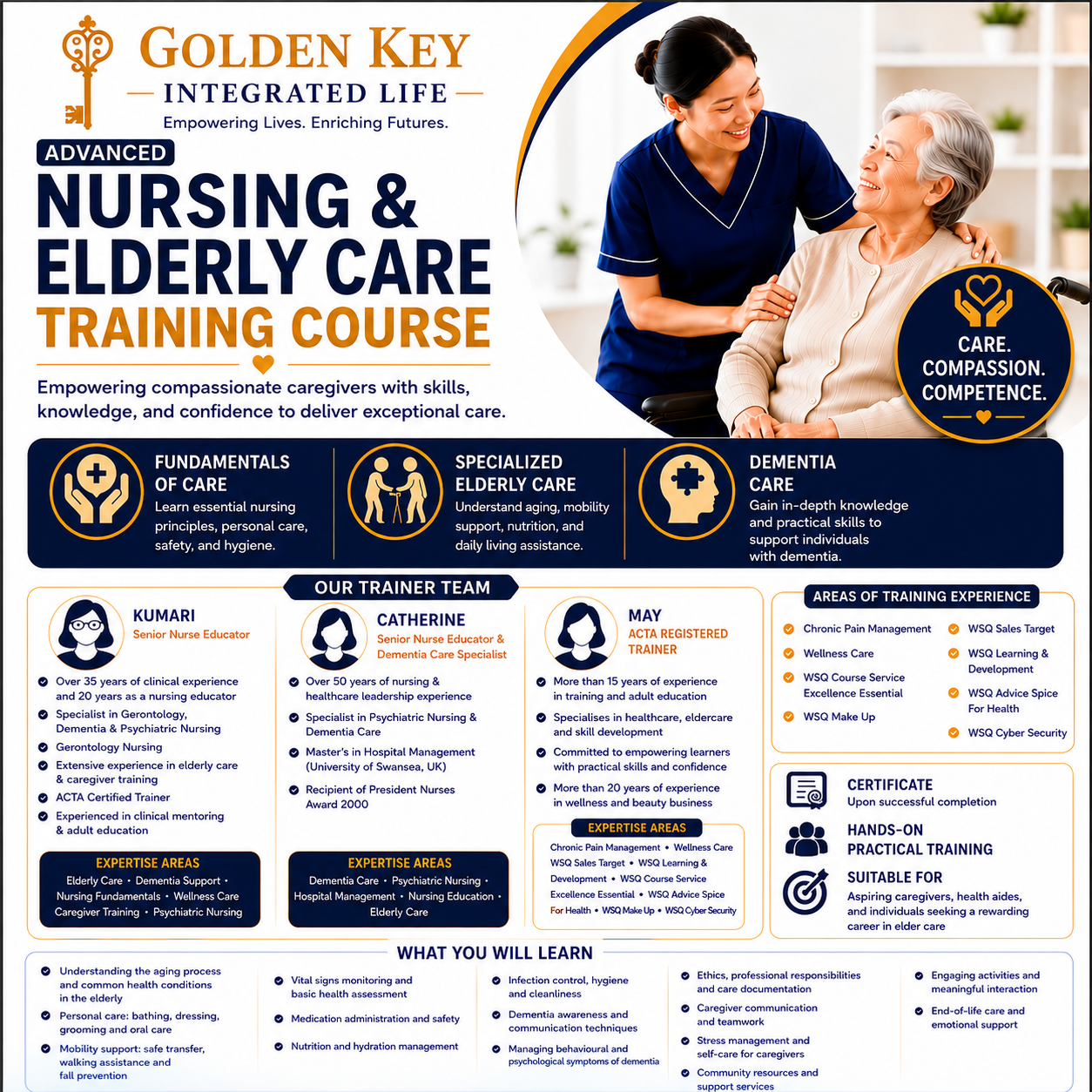
Nursing & Elderly Care Training Course
Advanced training for compassionate caregivers
S$1380.00
Elder Care and Healthcare Support Training
1. Module Purpose and Overview
Welcome to the Elder Care and Healthcare Support Training module.
This programme is designed to equip learners with essential knowledge, practical caregiving skills, and professional attitudes required to support elderly individuals in both healthcare and community care settings.
Learners will develop competencies in:
Understanding ageing-related conditions
Managing challenging behaviours
Applying safe caregiving techniques
Communicating effectively with elderly individuals
Delivering person-centred, safe, and respectful care
This training emphasises real-world application, ensuring learners can confidently perform caregiving duties in workplace environments.
1.1 Learning Outcomes
Upon completion of this course, learners will be able to:
1. Provide Safe and Effective Elderly Care
Deliver basic caregiving services safely and effectively, including hygiene care, feeding assistance, mobility support, and health monitoring
Apply proper techniques and safety practices to prevent injury, infection, and complications
2. Recognise Elderly Needs (Physical, Emotional & Cognitive)
Identify physical, emotional, and health-related needs of elderly individuals
Recognise common conditions such as Hypertension, Diabetes, and Arthritis
Understand emotional challenges such as loneliness, fear, and frustration
3. Apply Person-Centred Dementia Care
Recognise signs and symptoms of Dementia, including memory loss, confusion, and behavioural changes
Respond appropriately using structured approaches:
Observe → Approach → Reassure → Redirect
Provide safe, respectful, and supportive care for individuals with cognitive impairment
Adapt communication and care techniques to suit dementia patients
4. Apply Core Caregiving Skills in Practice
Perform caregiving tasks effectively, including:
Hygiene care
Feeding assistance
Patient handling and mobility
Basic health monitoring
Maintain patient comfort, dignity, and independence during care
5. Respond to Changes in Condition and Behaviour
Observe and identify changes in health, mood, and behaviour
Recognise warning signs (e.g. confusion, sweating, weakness)
Take appropriate action, including timely reporting and escalation
6. Demonstrate Professionalism and Caregiver Attitude
Show empathy, patience, and respect in all interactions
Maintain professional conduct and ethical caregiving practices
Ensure safety, dignity, and quality of life for elderly individuals
1.2 Learning Units
This course consists of the following modules:
Unit 1: Elder care fundamentals
Understanding the ageing process
Common elderly conditions (e.g. Hypertension, Diabetes, Arthritis)
Emotional needs of elderly individuals
Basic caregiver roles and responsibilities
Unit 2: Caregiving Skills
Hygiene care and personal care support
Feeding assistance and choking prevention
Infection control practices
Safe and effective caregiving techniques
Unit 3: Dementia Awareness
Understanding Dementia and its impact
Signs, symptoms, and behavioural changes
Stages of dementia
Person-centred dementia care and response techniques
Unit 4: Patient Handling
Safe transfer techniques (e.g. bed to wheelchair)
Proper body mechanics and posture
Positioning and mobility support
Fall prevention and safety awareness
Unit 5: Health Monitoring
Vital signs (temperature, pulse, breathing)
Observing changes in condition (appetite, mood, movement)
Identifying warning signs (e.g. confusion, weakness)
Reporting and escalation procedures
UNIT 6: COMMUNICATION SKILLS
· Use clear and simple verbal communication with elderly individuals
· Apply appropriate non-verbal communication (eye contact, body language)
· Adapt communication for elderly with Dementia or hearing difficulties
· Identify and understand causes of difficult behaviour
· Manage behaviour calmly by reassuring and redirecting
· Communicate effectively during caregiving activities
· Demonstrate empathy, patience, and professionalism
1.3 Assumed Skills and Knowledge
Learners are expected to have:
Basic understanding of Workplace Safety and Health (WSH) practices
Awareness of caregiving or healthcare environments (preferred but not mandatory)
Ability to follow organisational procedures and instructions
Basic English literacy (equivalent to WPL Level 3)
Basic numeracy skills
Learners who do not meet these requirements are encouraged to attend preparatory training to maximise learning effectiveness.
1.4 Target Audience
This course is suitable for:
Caregivers and healthcare support staff
Nursing aides and healthcare assistants
Community care and eldercare workers
Individuals seeking to enter the healthcare and eldercare sector
Training Delivery Methodology
Training will be conducted using a combination of:
Mini-lectures – to explain key concepts and frameworks
Interactive discussions – to encourage sharing and understanding
Group activities and role play – to practice real-life scenarios
Case studies – to apply knowledge in practical situations
Self-reflection exercises – to reinforce learning
Course Duration
Training Component | Duration |
Classroom Training | 14.5 hours |
Assessment | 1.5 hours |
Total Duration | 16 hours |
Statement of Attainment (SOA)
Learners will receive an SOA upon successful completion.
Requirements:
Minimum 75% attendance
Attempt all assessments
Achieve Competent in all required competencies
Certification:
Issued by SkillsFuture Singapore
Confirms achievement of required knowledge and skills under WSQ
Programme Info:
Modular programme; learners can complete more modules for full qualification
Assessment:
Based on knowledge, skills, and attitudes (refer to Assessment Plan for details)
Assessment Strategy Overview
Day 1 – Written Assessments
Learning Unit | Assessment Method | Duration | Assessor : Candidate Ratio |
Learning Unit 1 | Written Assessment (WA1) | 10 minutes | 1:20 |
Learning Unit 2 | Written Assessment (WA2) | 10 minutes | 1:20 |
Learning Unit 3 | Written Assessment (WA3) | 10 minutes | 1:20 |
Day 2 – Role Play Assessments
Learning Unit | Assessment Method | Duration | Assessor: Candidate Ratio |
Learning Unit 1 | Role Play (RP1) | 10 minutes | 1:1 |
Learning Unit 2 | Role Play (RP2) | 10 minutes | 1:1 |
Learning Unit 3 | Role Play (RP3) | 10 minutes | 1:1 |
Learning Unit 4 | Role Play (RP4) | 10 minutes | 1:1 |
Learning Unit 5 | Role Play (RP5) | 15 minutes | 1:1 |